

Mithila Museum
Art &
Symbolism
Forms that are not merely ornamental — carrying layered symbolism tied to family life, ritual practice, devotion, ecology, and social memory.
Image & Meaning
A Strong Relationship
Between Image and Meaning
Mithila painting is defined by a strong relationship between image and meaning. Its forms are not merely ornamental; they carry layered symbolism tied to family life, ritual practice, devotion, ecology, and social memory.
Smarthistory describes Mithila painting as rich in auspicious symbols associated with blessing, fertility, love, and well-being, especially in relation to marriage and sacred occasions.
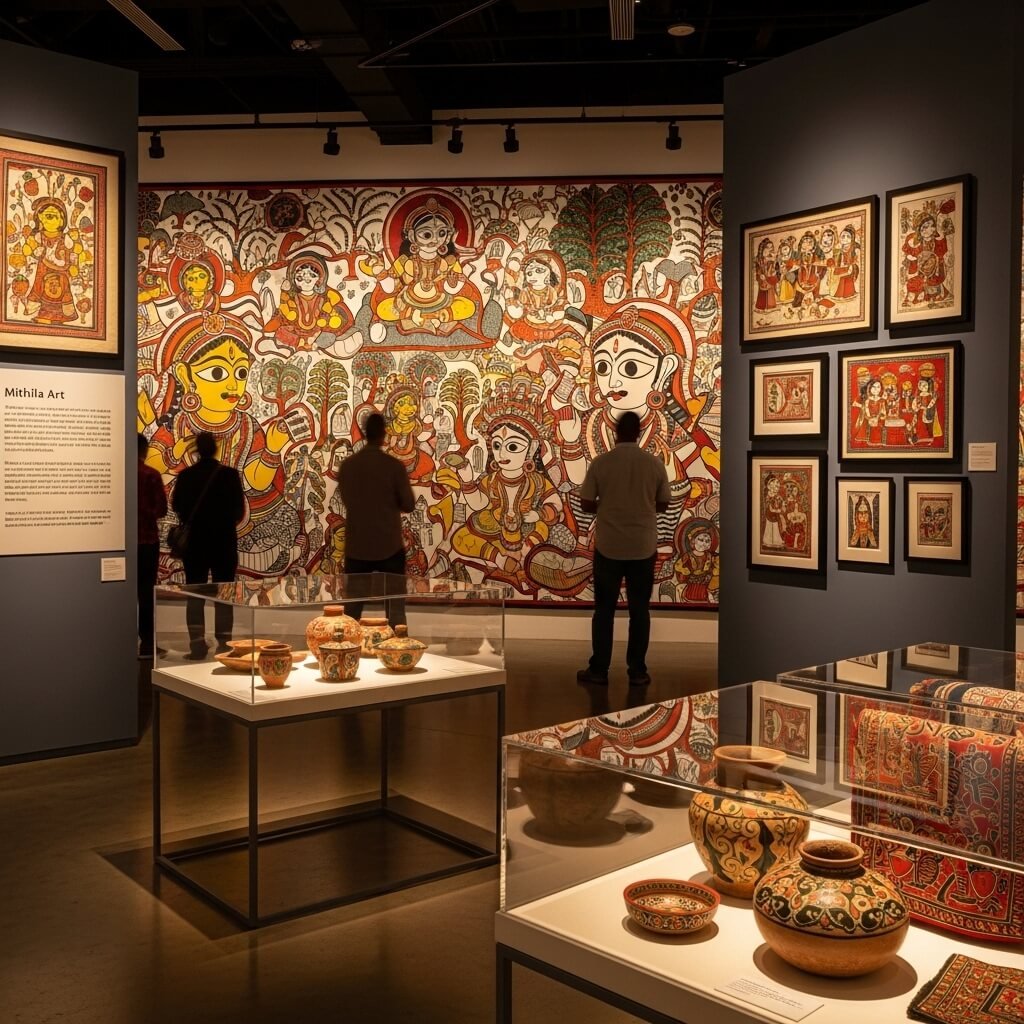
The Symbolic Language
A Total World of
Signs & Patterns
This symbolic language often includes gods and goddesses, celestial references, plants, animals, serpents, lotus forms, fish, birds, and geometric structures. Many of these motifs function both visually and conceptually — they animate the composition, but they also communicate values and beliefs.
Gods & Goddesses
Divine figures carry sacred blessing and cosmic order into the painted space.
Lotus Forms
The lotus is among the most enduring symbols — purity, beauty, and spiritual awakening.
Birds & Fauna
Birds, fish, and animals appear throughout, embodying fertility, nature, and continuity.
Serpents
Serpent forms evoke protection, renewal, and the sacred energy of the natural world.
Geometric Forms
Tantra-derived geometric signs and structures organize the painted field with cosmic logic.
Celestial References
The cosmos, stars, and heavenly bodies link domestic painting to wider spiritual order.
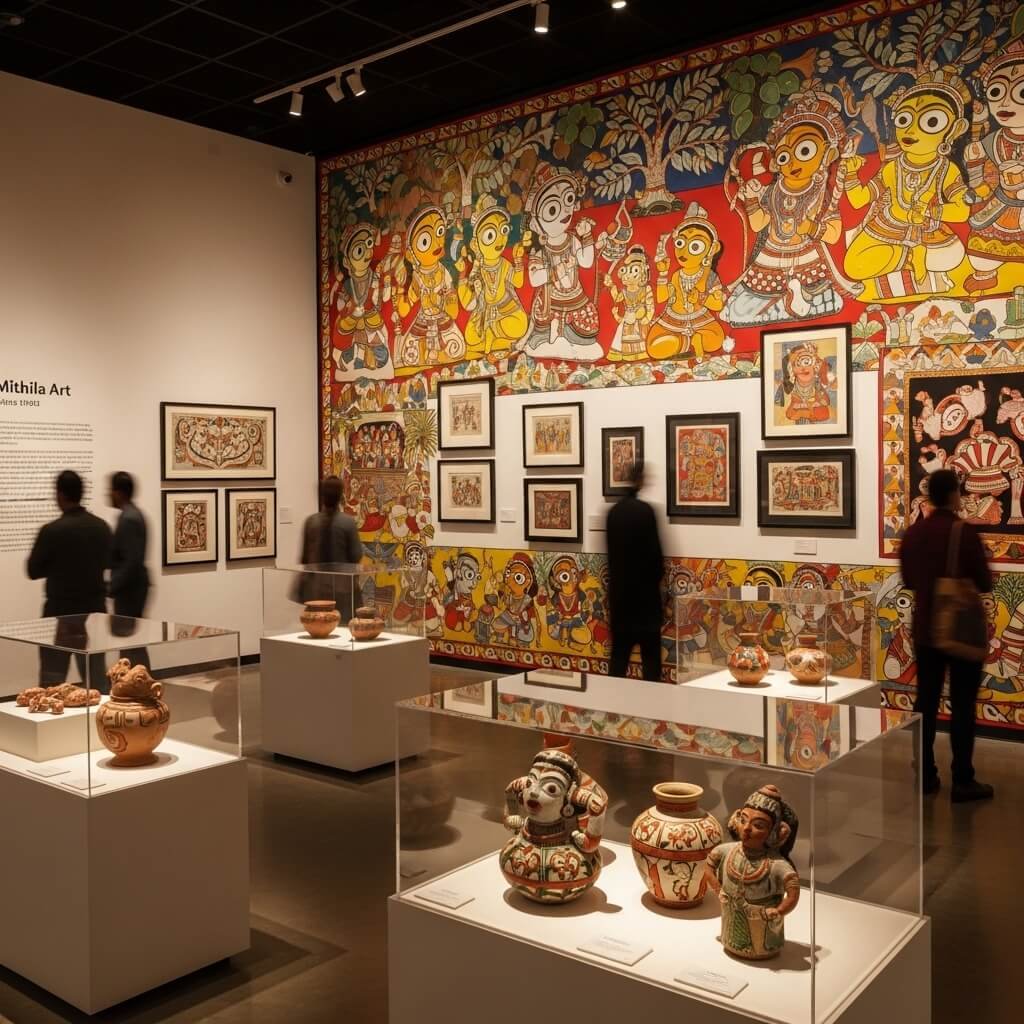
A total world of signs, patterns, and relationships.
Visual Density & Force
Surface as a Field of
Concentrated Attention
Another defining quality of Mithila art is the way it turns surface into a field of concentrated attention. Empty space is often minimized, and the painting becomes a total world of signs, patterns, and relationships.
This density gives Mithila painting much of its force. It invites close reading while still carrying immediate visual impact.
Filled Surfaces
Empty space is minimized — every area of the surface contributes meaning.
Patterned Spaces
Rhythm and repetition give compositions their visual coherence and force.
Close Reading
Invites sustained attention — the more you look, the more you find.
For the Museum Initiative
Three Levels at Once
Art & Symbolism should help visitors understand that Mithila painting operates on at least three levels simultaneously.
Aesthetically Compelling
As painting, Mithila works carry immediate visual power — through line, density, colour, and compositional energy.
Culturally Rich
As a bearer of tradition, each painting carries the knowledge, ceremonies, and values of Mithila cultural life.
Intellectually Meaningful
As a visual system, it represents protection, celebration, devotion, identity, and continuity — a language that rewards study.
The Museum’s Role
Not Only to Admire —
But to Read
A future Mithila Museum can make this especially powerful by pairing close visual interpretation with broader public education: helping audiences not only admire the paintings, but learn how to read them.
This means bringing the symbolic language to life — so that visitors leave not just moved by the images, but equipped with new ways of seeing.
Museum Approach